Geological Processes and Plate Tectonics
Earth's Internal Structure
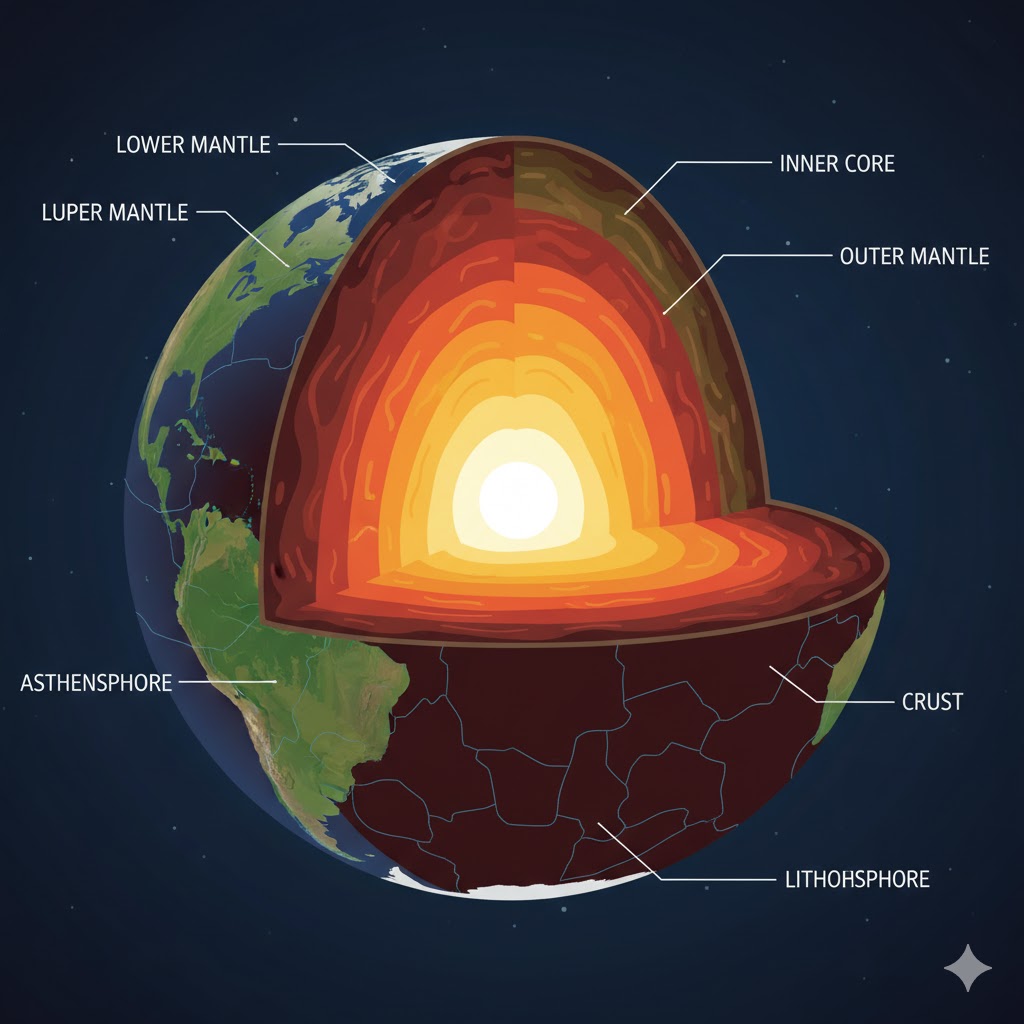
The Earth is made up of different layers, similar to an onion, based on their chemical makeup and physical properties. These layers are the crust, the mantle, and the core.
The Crust and Lithosphere
The crust is the Earth's thin, outer shell that we live on, ranging from 6 km to 70 km thick.
- Continental Crust makes up the land. It is less dense and made mostly of granite rock.
- Oceanic Crust is found under the ocean floor. It is denser and made mostly of basalt rock.
- The Lithosphere is the entire rigid, solid layer that includes the crust and the very top, cool part of the mantle. This layer is broken up into the large puzzle pieces called tectonic plates.
The Mantle
The mantle is Earth's thickest layer, extending to about 3000 km deep.
- Composition and Movement: It is made of dense rock rich in iron (Fe) and magnesium (Mg). Even though it's solid, the extreme heat causes it to behave like a very thick, plastic-like material, allowing it to flow slowly over millions of years.
- Asthenosphere: This is the softer, hotter upper part of the mantle. It is where slow-moving, circular currents of heat (convection currents) are thought to happen, providing the force that pushes the plates around on the surface.
The Core
The core is made primarily of iron and nickel.
- Outer Core: This layer is molten liquid iron and nickel. The movement of this metal liquid creates Earth's magnetic field, which protects the planet from solar radiation.
- Inner Core: The very center is solid iron and nickel. Despite being the hottest layer (around 6000°C), the extreme pressure keeps it solid.
Tectonic Plates and Continental Movement
The Continental Drift Hypothesis
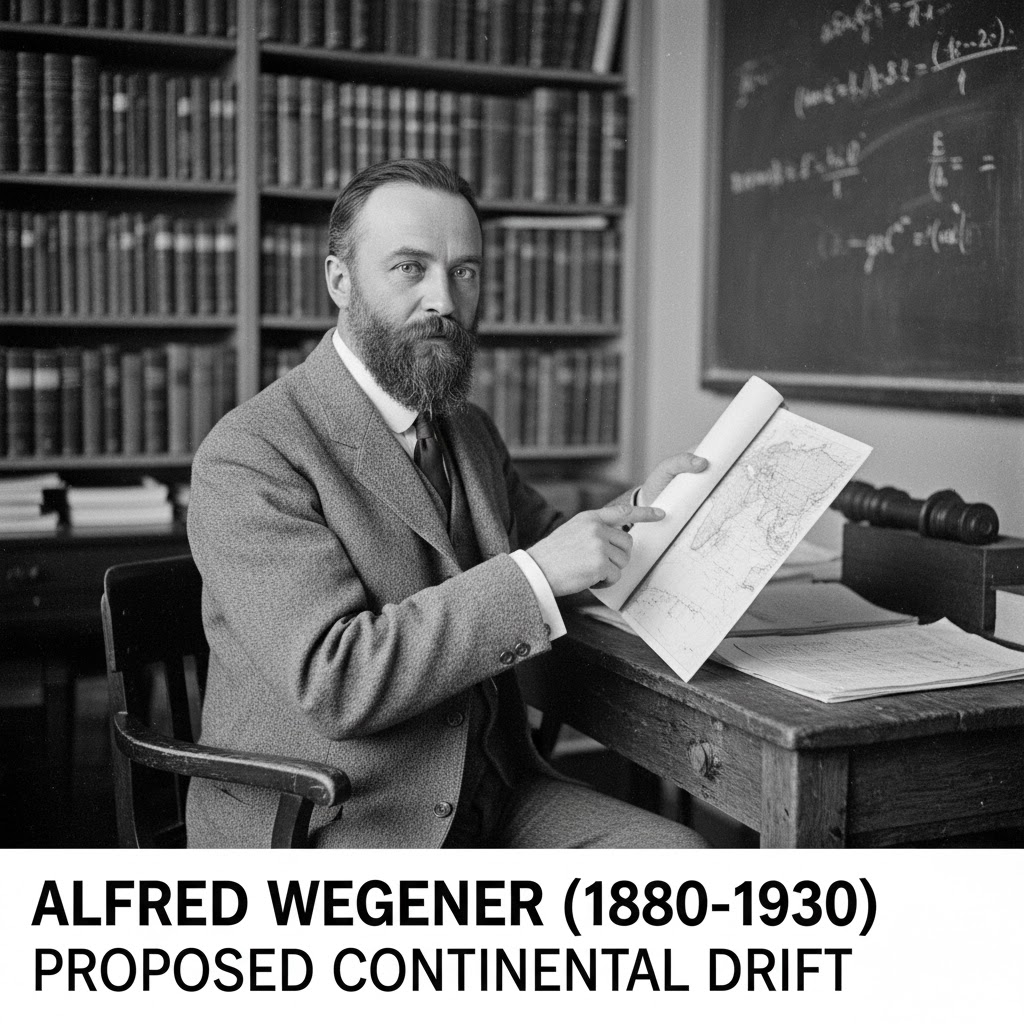
In the early 1900s, Alfred Wegener proposed the idea of Continental Drift. He suggested that all continents were once joined together in a single giant supercontinent called Pangea. Evidence supporting this included matching continental shapes, identical fossil species found across oceans, and ancient glacial grooves on currently tropical continents.
Seafloor Spreading
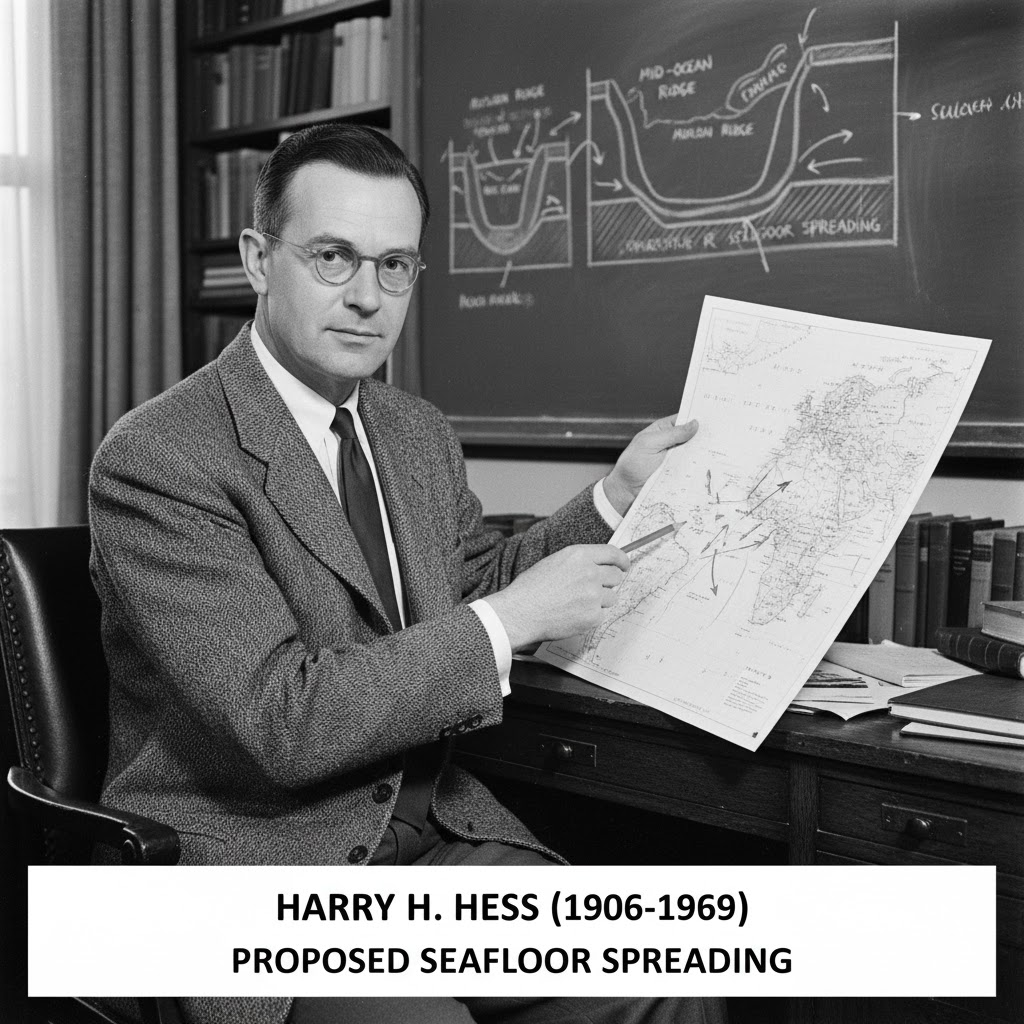
Henry Hess provided the key mechanism of movement with the theory of Seafloor Spreading. This theory explains that new crust is constantly formed at mid-ocean ridges and then moves outwards. Old crust is destroyed when it sinks back into the mantle at deep ocean trenches (subduction). Evidence like the age of the seafloor and the symmetrical magnetic striping confirms this constant process of crust creation and destruction.
Major Tectonic Plates
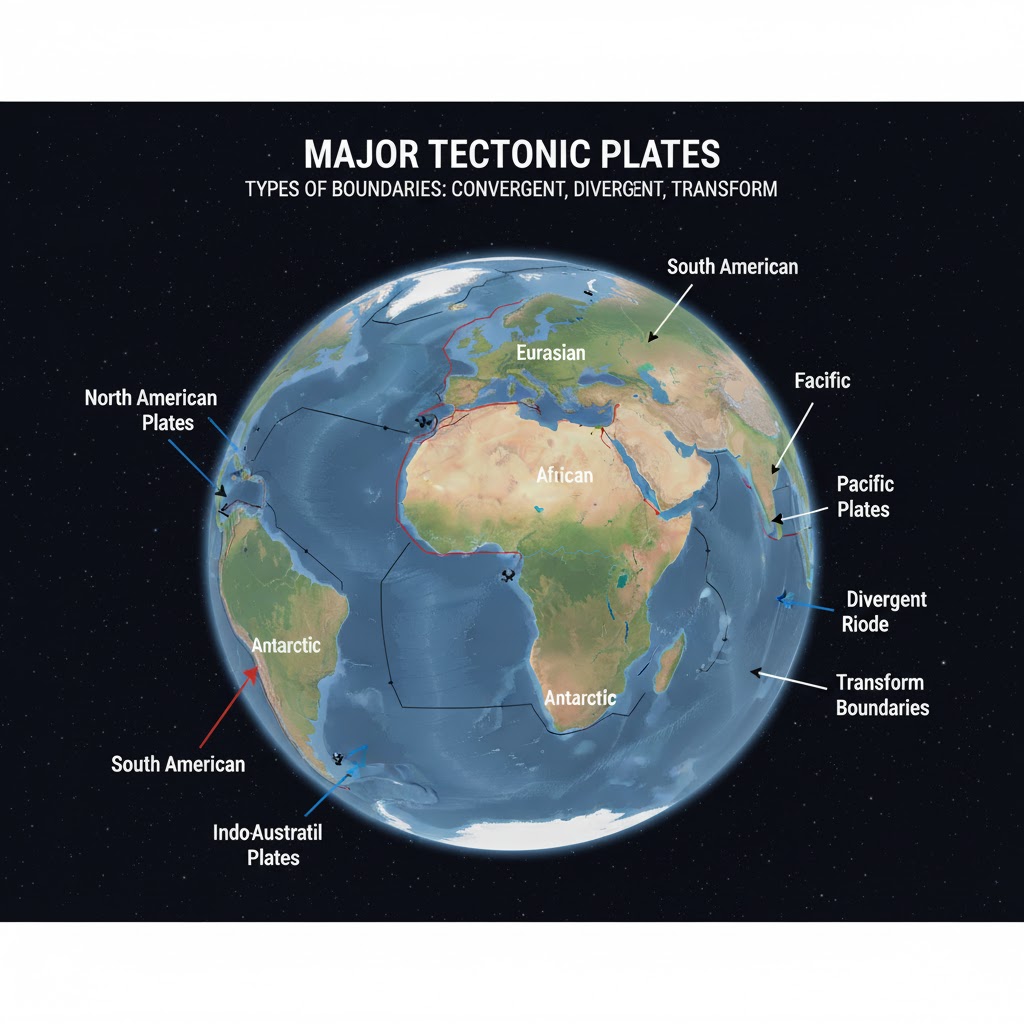
The Earth's lithosphere is divided into several major and minor tectonic plates. These plates float and move independently on the plastic-like asthenosphere.
| Tectonic Plate | Location | Type | Key Boundary Interactions |
|---|---|---|---|
| Pacific Plate | Mostly under the Pacific Ocean. | Oceanic | Subducting under most surrounding plates (e.g., Japan, Tonga, North American). Creates the "Ring of Fire." |
| North American Plate | North America, Greenland, and part of the Atlantic Ocean floor. | Continental & Oceanic | Divergent with Eurasian Plate (Mid-Atlantic Ridge); Transform with Pacific Plate (San Andreas Fault). |
| Eurasian Plate | Europe, Asia, and much of the oceanic crust between them. | Continental & Oceanic | Divergent with North American Plate; Convergent with Indian Plate (Himalayas). |
| Indo-Australian Plate | India, Australia, and surrounding oceanic crust. | Continental & Oceanic | Convergent with Eurasian Plate (forming the Himalayas and Indonesian Arc). |
| African Plate | Africa and the surrounding oceanic crust. | Continental & Oceanic | Divergent on all sides (Mid-Atlantic Ridge, East African Rift Valley). |
| South American Plate | South America and part of the Atlantic Ocean floor. | Continental & Oceanic | Convergent with the Nazca Plate (Andes Mountains); Divergent with the African Plate. |
| Antarctic Plate | Antarctica and the surrounding ocean floor. | Continental & Oceanic | Mostly surrounded by divergent boundaries. |
| Nazca Plate | Under the Pacific Ocean, west of South America. | Oceanic | Subducting beneath the South American Plate. Responsible for the Andes Mountains and intense earthquakes. |
Plate Boundaries: Where Plates Meet
Geological activity (mountains, volcanoes, earthquakes) mostly occurs at plate boundaries, the edges where tectonic plates interact.
- Divergent Boundaries (Pulling Apart):Plates move away from each other. Magma rises to fill the gap, cools, and creates new crust. This forms mid-ocean ridges and rift valleys.
- Convergent Boundaries (Colliding): Plates crash into each other.
- If one plate is dense oceanic crust, it is forced down into the mantle (subduction), forming deep trenches and volcanic mountains.
- If two continental plates collide, the land buckles and folds to create high fold mountains (like the Himalayas).
- Transform Boundaries (Sliding Past): Plates slide horizontally past each other. This motion builds up massive stress that is released suddenly as powerful earthquakes along fault lines.
Earth's Activity: Volcanoes and Earthquakes
Volcanoes
The type of volcano formed depends on the magma's viscosity (how easily it flows), which is determined by its silica content.
- Stratovolcanoes (Composite): Found at convergent boundaries. Magma has high silica content, making it sticky. The sticky lava plugs the vent, causing extreme pressure and violent, explosive eruptions. They have a steep, conical shape (e.g., Krakatoa).
- Shield Volcanoes: Found at divergent boundaries or hotspots. Magma has low silica content, making it runny. The lava flows easily and widely, resulting in non-explosive eruptions and a broad, gently sloping shape (e.g., Mauna Loa, Hawaii).
Earthquakes
An earthquake is the sudden release of energy when two tectonic plates suddenly slip past each other at a plate boundary.
- Focus: The point deep underground where the rupture starts.
- Epicenter: The point on the Earth's surface directly above the focus, where shaking is strongest.
- Hazards: Strong earthquakes can cause damage, landslides, tsunamis, and liquefaction, where wet soil turns temporarily liquid.
Real-World Geological Markers
The points marked on the model show major geological features and plate interactions worldwide:
- Solomon Islands Convergent Boundary: This is an oceanic-oceanic collision where the dense Pacific Plate is sinking (subducting) under the Solomon Sea Plate. This process started about 40 million years ago and creates volcanic islands and frequent earthquakes.
- Hawaii Islands Hotspot: This volcano chain is created by a fixed, superheated mantle plume (hotspot) under the middle of the Pacific Plate. As the plate moves slowly over the plume, it leaves a trail of volcanoes behind it. The process proves the Pacific Plate has been moving for an estimated 80 million years.
- Himalayas Continental Collision: This is a continental-continental convergence that began about 50 million years ago. The Indian Plate is still crashing into the Eurasian Plate. Because neither plate sinks, the crust piles up and folds, creating the world's highest mountains.
- Japan Trench Subduction Zone: Here, the Pacific Plate is sinking steeply beneath the Okhotsk Plate. This subduction creates the deep Japan Trench and is the reason for the intense volcanic activity and high risk of large earthquakes across Japan.
- Mid-Atlantic Ridge Divergent Boundary: This massive underwater mountain range is a major divergent boundary where the American and Eurasian/African plates are pulling apart. New oceanic crust is constantly being formed here, a process that has been widening the Atlantic Ocean for around 200 million years.
- San Andreas Fault Transform Boundary: This is a famous transform fault in California where the Pacific Plate is sliding horizontally past the North American Plate. This sideways motion causes enormous stress to build up, which is released as frequent, powerful earthquakes.
- Iceland Rift Zone Divergent and Hotspot: Iceland is unique because the Mid-Atlantic Ridge runs right through it, making the spreading visible on land. An underlying hotspot causes extra volcanic activity and leads to the North American and Eurasian plates moving apart quickly, at about 2.5 cm per year.
- Mariana Trench Subduction Zone: This is the deepest point on Earth. It is formed by oceanic-oceanic convergence, where the old, dense Pacific Plate is forced steeply beneath the Mariana Plate. This extreme process of crust destruction has been ongoing for over 50 million years.
- East African Rift Continental Rift Zone: This is an active divergent boundary where the African continent is currently being stretched and pulled apart. Over tens of millions of years, this stretching is expected to fully split the continent and create a new ocean basin.
- Tonga Trench Convergent Boundary: This area features the fgastest plate movement on Earth, with the Pacific Plate subducting beneath the Tonga Plate at over 20 cm per year. This rapid subduction creates the deep trench and generates very powerful earthquakes.
Examine the markers on the Earth model to see real-world examples of these boundaries and geological processes!